Anyone responsible for relevance in an e-commerce environment will recognize the pattern. Recommendations often fall back on two familiar anchors: what an individual visitor has done before, or what sells well in general.
Both approaches are logical, but also limited. Individual behavior is often scarce or still developing. Popularity says little about personal preference. In practice, this leads to recommendations that are either too narrow or too generic.
The result is that many recommendation blocks fail to reach their full potential. They confirm what someone already knows, but do too little to help discover what is still unknown.
Personalization based on individual behavior is valuable, but incomplete. Especially in the early phase of a session, there is simply too little context. A visitor views a few products, compares some options, and is still exploring.
At that stage, behavior mainly indicates direction, but not yet preference. Someone viewing multiple sports shoes may still have very different intentions: running, casual use, or training.
In addition, behavior is not always linear. Visitors browse broadly, click back, compare categories. If recommendations stay limited to that individual trail, they miss an important part of the story.
The next step in personalization does not lie in more rules or finer segmentation. That approach quickly gets stuck in complexity and maintenance.
The shift lies in using patterns at scale. Not looking at one visitor, but at groups of visitors with similar behavior.
Purchase and browsing behavior are rarely completely unique. Within larger datasets, patterns emerge: combinations of products that are often viewed together, journeys that more often lead to a purchase, preferences that repeat within groups with similar intent.
This is the core of collective intelligence. Not learning from isolated signals, but from behavioral overlap. Personalization then shifts from reactive to more predictive: not only responding to what someone does, but anticipating what is likely to become relevant.
From that way of thinking, a different way of recommending emerges.
This creates a third type of recommendation alongside the familiar forms:
The distinction is not only in the source of the data, but in the type of insight. Where the first two forms mainly respond to what is already happening, collective behavior adds a broader, learning layer.
Imagine a visitor views multiple sports shoes within a certain price range and style. Based on individual behavior, the system stays close to that selection. Based on popularity, mainly the best-selling models appear.
But when you look at what similar visitors do, a different picture emerges. It may turn out that many of these visitors eventually choose a specific model just outside the initial selection. Or that they often add a certain type of socks or accessories to their purchase.
These are connections you do not derive from one session, but from the behavior of a larger group.
By using those patterns, recommendations become less dependent on what someone has already explicitly shown, and more based on what proves relevant in similar situations.
The value of this approach lies first of all in relevance. Recommendations align better with the visitor’s stage and direction.
But the effect goes further. Because the system recognizes connections beyond direct behavior, it also helps with discovery. Visitors find products more quickly that they had not yet actively found themselves.
This can lead to a more natural form of cross-sell and a smoother decision-making process. Not because more is shown, but because what is shown better matches the underlying need.
It is important to see this as a potential effect, not a guaranteed outcome. Impact always depends on assortment, traffic, and implementation. But the direction is clear: better signals lead to more relevant choices.
Collective behavior does not replace other forms of personalization. It adds an extra layer.
Individual behavior remains essential for refinement. Contextual recommendations remain valuable within a specific page or category.
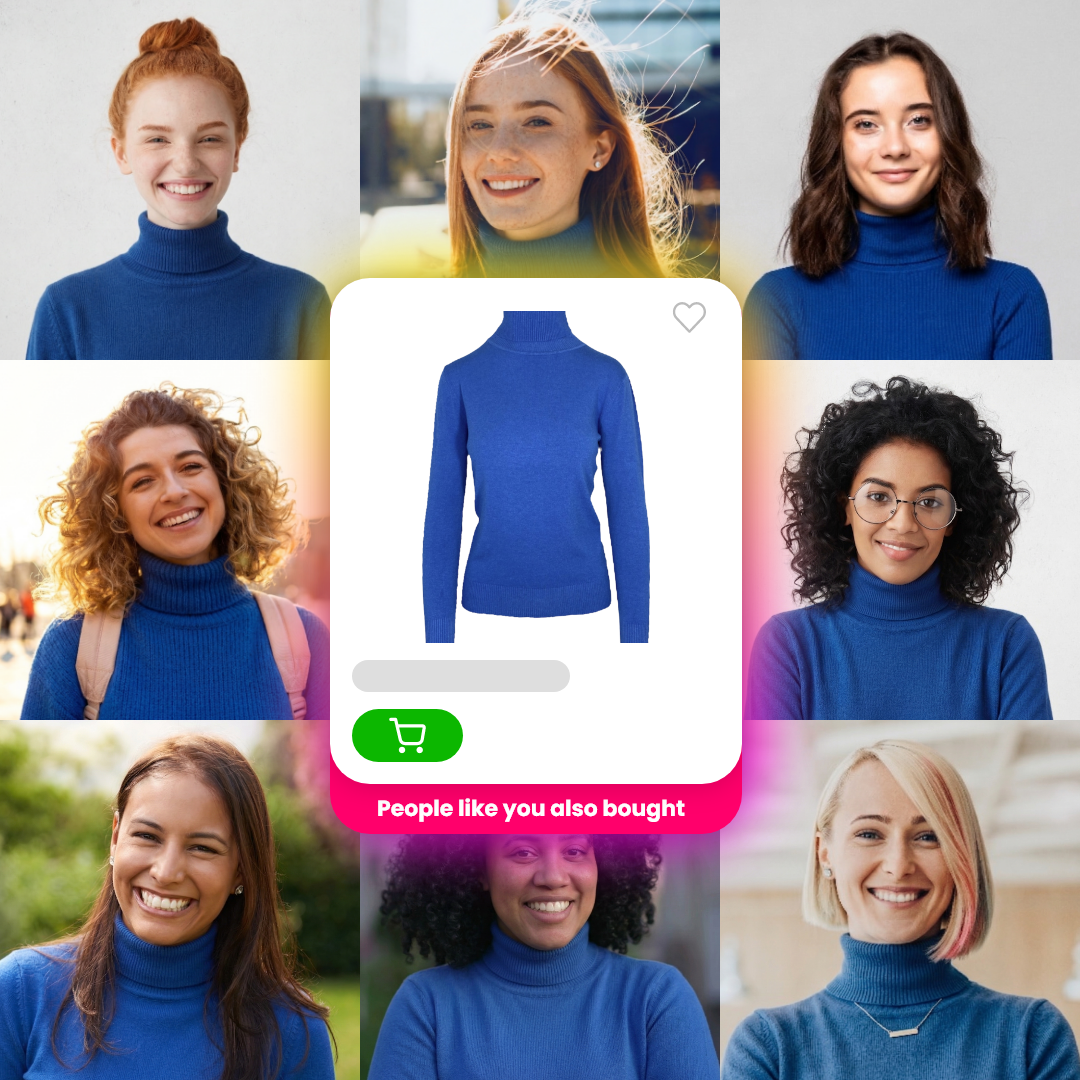
People Like You complements this with insights that would otherwise remain invisible. It brings forward patterns that cannot be directly derived from one user or one context.
It is precisely in the combination that a more robust form of personalization emerges. A system that does not rely on one type of signal, but brings multiple perspectives together.
People Like You reduces dependence on manual personalization. Instead of setting up and maintaining rules, the system learns from behavioral patterns. This makes it possible to improve relevance without added complexity.
In addition, personalization becomes more scalable. More data leads to stronger patterns, allowing recommendations to better match different intentions and stages in the process.
At the same time, a shared and more concrete view emerges of what visitors actually do. Teams steer less on assumptions and more on proven patterns. That leads to sharper decisions, shorter discussions, and more focused optimization.